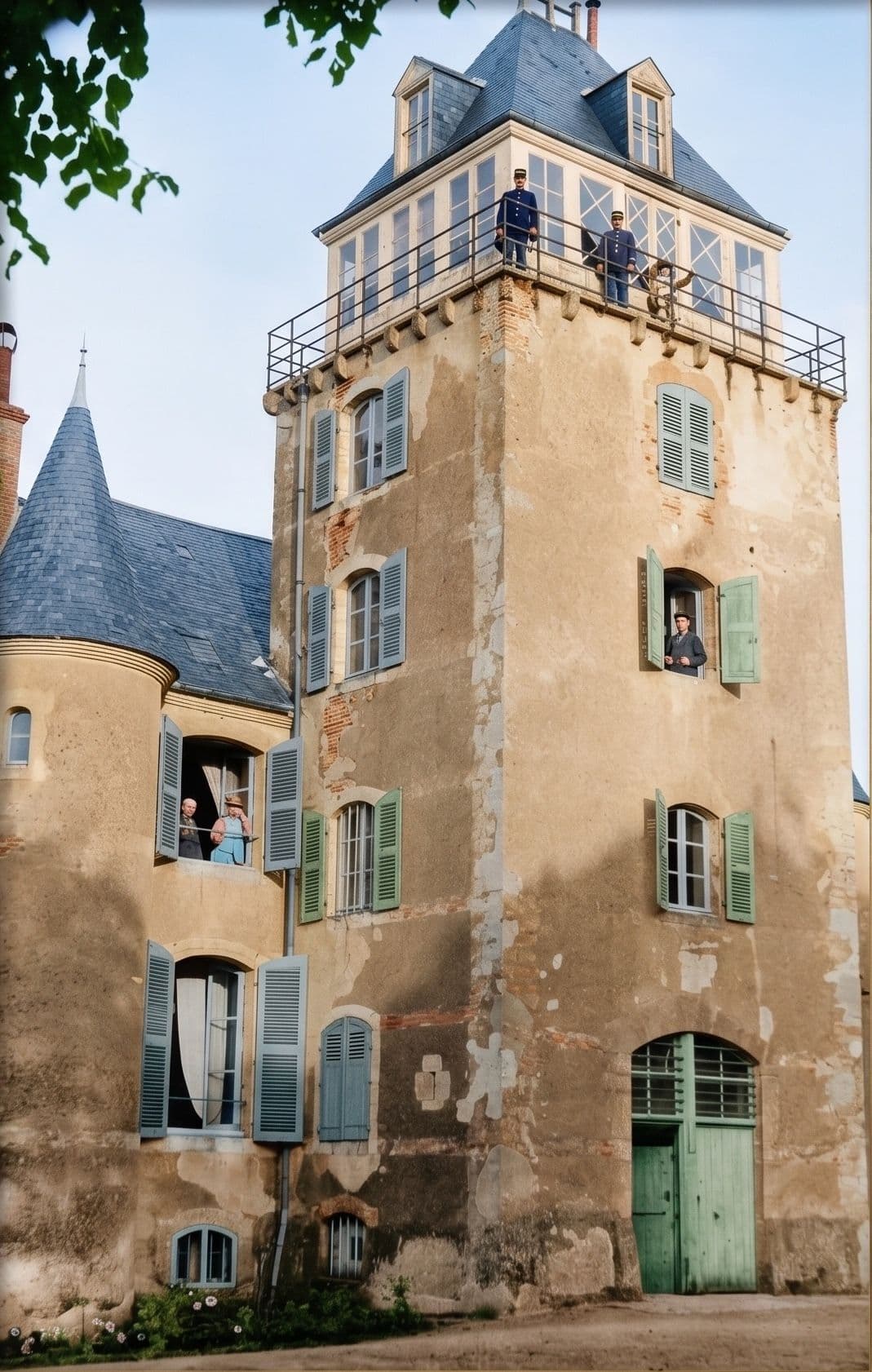
La Goupillère seen from the inside: family stories since 1949
From 1949 to the end of the 1980s, Hercé's family lived in La Goupillère. Christian, son of the house, recorded his memories in 2019: the vintage cars, the horses Opera B and L'Eclair, the little donkey Gamin, the Montmirail fairs and the wisteria terrace. An intimate memory of a historic estate in Perche Sarthois. (Reading: 6 min)
There are places that never let you go. La Goupillère is one of them. Christian de Hercé, whose family lived within these walls from 1949 to the end of the 1980s, understood this better than anyone. In 2019, he put down on paper his memories of the estate, stories of childhood and youth which smell of hot straw, motor oil and Perche Sarthois grass after the rain. Here, in her own words and in the spirit that animated her, is the intimate story of La Goupillère as she lived her daily life.
Classic cars: a passion passed down
One of Christian's first memories is the smell of garages. His father loved beautiful mechanics, and La Goupillère was home to several of them. A Bentley from the thirties sat in the shed with the quiet majesty of objects too beautiful to be used often. Next to it, a Talbot and a few other collector's items awaited the Sunday outings on the roads of Perche Sarthois. For the children of the house, these cars were not museum relics but playmates, secret refuges with the smells of aged leather and old grease.
Christian remembers the afternoons spent polishing bodies under the direction of his father, dismantling small mechanisms without really understanding how they worked, but with the certainty that this work mattered. These moments in the garages of La Goupillère transmitted to him a taste for heritage, not only that of stones and trees, but also that of objects shaped by the hands of men and preserved with care. Sarthe, land of racing and mechanics, was no stranger to this passion.
Opera B and L’Eclair: the horses of the estate
But what really beat at the heart of La Goupillère were the horses. Opera B and L'Eclair, two superb beasts of which Christian speaks with a tenderness that has never faded, reigned over the estate's meadows. Opera B was a horse of character, lively, a little unpredictable, the kind that forces you to be attentive at all times. The Lightning deserved its name: fast, luminous, it darted along the paths of the park as if the earth beneath its hooves was made for it.
On summer mornings, before the heat set in on the Perche Sarthois, the children of the house saddled the horses in the old saddlery, this beautiful room with the smells of leather and hay which today gives its name to the gîte. This is where the days took off, in the softness of dawn and the sound of hooves on the cobblestones of the courtyard. The walks led towards the woods of the estate, towards the Huisne valley or the sunken paths which connect the hamlets of Tuffé Val de la Chéronne.
Kid, the little philosophical donkey
Alongside the prestigious horses lived Gamin, a little donkey with a strong character whom the whole family secretly loved more than anyone would like to admit. Kid only obeyed himself. He grazed wherever he pleased, stopping without warning in the middle of the paths, and looking at humans with that slightly condescending air specific to his species. Children adored him precisely for that, for this quiet freedom that he effortlessly embodied.
Christian says that Gamin had his own way of participating in the life of the estate: he always appeared when he was least expected, emerging from a corner of the meadow or shamelessly mingling with walkers. In a historic estate like La Goupillère, with its 250 hectares of woods and meadows, a philosophical donkey found something to occupy his days.
Neighboring farmers: a living rural community
La Goupillère did not live withdrawn into herself. The estate was surrounded by working farms whose owners maintained good neighborly relations with the family, based on mutual aid and respect. We lent each other equipment at hay time, we exchanged news at the Tuffé market, we met at local festivals which marked the calendar of rural life in Perche Sarthois.
For Christian, these farmers embodied a form of wisdom rooted in the Sarthoise land, an intimate knowledge of the seasons, animals and men which impressed the young boy that he was. These links with the surrounding agricultural world gave him the sense of what an estate like La Goupillère represents in the human fabric of the Sarthe countryside: not an isolated castle in its park, but a knot of relationships, shared stories and collective memory.
The Montmirail stable and the great horse fairs
The family did not remain confined to La Goupillère. The large stables of Montmirail, not far away in Sarthe, were a regular attraction. The horse fairs held there brought together owners, dealers and enthusiasts from across the region in an atmosphere reminiscent of a medieval market and exhibition hall. People came to see, compare, negotiate, but above all feel the pulse of this equestrian civilization which was still very much alive in Sarthe in the 1950s and 1960s.
These expeditions to Montmirail remain in Christian's memory as days of celebration. The excitement of the stable yards, the conversations between connoisseurs, the sound of irons on the cobblestones, everything combined to create a unique atmosphere. La Goupillère participated in this collective equestrian life of Perche Sarthois, which continued from generation to generation as a tradition deeply rooted in the identity of the region.
The terrace and the water pump: daily rituals
But the daily soul of La Goupillère was perhaps the terrace. Facing south, sheltered by century-old wisteria which bloomed each spring in purple and fragrant clusters, it was the place for all family gatherings. We had summer meals there, we read there in the long afternoons, we received neighbors and passing friends there. The terrace was the centerpiece of a house that was not afraid of space.
Not far away, the old manual water pump was another immutable landmark of the estate. It sat in the courtyard with the solidity of things made to last, and the children loved to operate it rhythmically, with the characteristic sound of metal and water rising from the depths. These repetitive gestures, this direct relationship with water and earth, were part of an informal education that La Goupillère naturally provided to those who grew up within its walls.
A living heritage, a transmitted memory
What emerges from these stories by Christian de Hercé is that La Goupillère was not a setting but an actor. The castle and its outbuildings, the meadows and woods of Perche Sarthois, the animals and the people who lived there formed a coherent whole, a miniature world which had its rules, its rhythms and its joys. La Goupillère from 1949 to 1989 was still what the historic estates of Sarthe were for centuries: a complete place to live, self-sufficient in spirit if not in fact.
Today, Arnaud and Catherine Le Saige perpetuate this spirit by opening La Sellerie, the former saddlery of the marquises, to visitors looking for something other than simple accommodation. Staying at La Goupillère means entering into this story spanning more than eight centuries, of which Christian de Hercé has preserved, with admirable fidelity and tenderness, some essential chapters.
Want to stay at La Goupillère?
Discover La Sellerie, a historic outbuilding of the estate, 30 minutes from Le Mans.
Book La Sellerie